In the absence of market sales data, pharmaceutical and medical device manufactures need to turn to alternative measures.
In UK private healthcare, sales data is scarce, siloed, and sensitive. For pharmaceutical companies, medical device manufacturers, and healthcare investors, that creates a measurement problem: how do you track brand performance when the underlying commercial data is unavailable?
The recurring question we hear from clients is how to understand market share and penetration in the absence of industry-wide sales data. In response, Rare. developed a different metric: Brand Amplification. It does not replace sales data. It is the next best thing where sales data does not exist.
What Brand Amplification measures
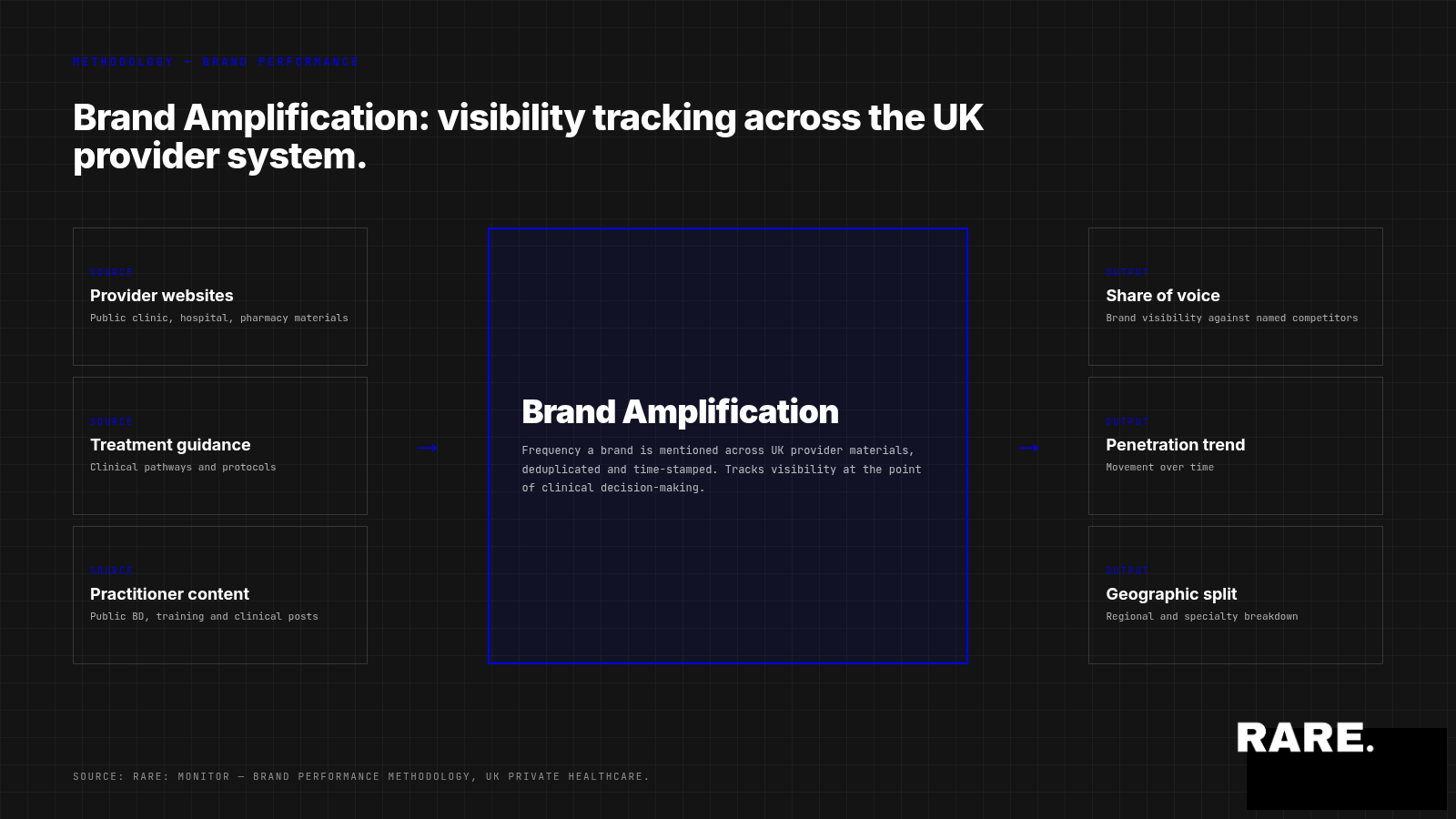
Brand Amplification is the extent to which UK healthcare providers, hospitals, clinics, pharmacies, medispas, and surgeons, mention specific brands in public-facing materials: documents, policies, treatment guidance, marketing pages, and clinical publications. Each mention is a signal of brand visibility in the spaces where treatment decisions are made and communicated.
Mentions are aggregated, deduplicated, and time-stamped. Tracked over time, Brand Amplification gives a credible directional read on:
How well a brand is penetrating the healthcare provider system.
How visibility compares against named competitors using a like-for-like measure.
Which regions, treatment categories, or specialties show the strongest traction.
Whether internal commercial strategy, BD, or investor narrative are supported by external visibility data.
Why it works particularly well for B2B2C brands
For brands operating through B2B2C models, where the manufacturer sells to the provider and the provider delivers to the patient, Brand Amplification is more than a workaround. The brands in those models are typically more active in provider-facing communication, which means visibility in public channels is a closer reflection of real-world engagement than it would be in a pure-B2C model.
In that context, Brand Amplification becomes a leading indicator of market interest, adoption, and growth, often visible weeks or months before sales data would show the same trend.
Why Rare.Monitor
Rare.Monitor brings together provider-level data from across the UK healthcare system, which is the substrate that makes Brand Amplification work. The platform offers near real-time tracking of brand mentions, historical trends, competitor comparisons, and dashboards segmented by brand, therapy area, or geography.
The key constraint of the methodology is that it draws only on public information. No confidential sales data, no regulatory grey zones, just decision-grade intelligence assembled from materials that providers have chosen to publish. That is part of the point: Brand Amplification can be shared internally and externally without the data-protection caveats that come with traditional commercial data.
What it means for the market
UK private healthcare has long been data-poor on commercial performance. That has constrained how manufacturers and investors plan, benchmark, and report. Brand Amplification, run continuously across the provider base, closes part of that gap. It is not the same as sales share, and we are explicit with clients about the difference. But for understanding how a brand is moving inside the UK private healthcare system, it is the most useful single metric available, and it is built specifically for the structure of this market.